
2025 Recipient: Thomas Yee
 Early in his research career, Thomas developed a large umbrella-class of regression models that generalise generalised linear models and generalised additive models. He described this class as “Vector Generalized Linear and Additive Models” with the characteristic that any of the parameters of a base model can be replaced by linear or smooth regression functions of covariates. The class also includes his reduced-rank vector generalised linear models which provide for dimension reduction. Because the VGAM framework covers such a wide swathe of well-known statistical models, the many theoretical and methodological advances that Thomas makes are implemented in his R package VGAM for the full range of models to which they are appropriate. The most complete single account of the VGAM models, and the results of his research in the area at the time, is his 590-page magnum opus published by Springer in 2015. A second edition invited by Springer is well under way.
Thomas’s written research is impressive, but I think an even bigger contribution is his ongoing work on his open-source R package VGAM. This is where he first publishes most of his innovations to provide research communities with new, immediately-useable modelling and analysis capabilities. Having so many models linked within a single coherent family makes it enormously easier for researchers to move between models in search of something that better models their data. I’m also reminded that Hadley Wickham’s software is his most important set of research outputs and that Hadley won the 2019 COPSS Award, showing recognition of this form of publication at the highest level. In my view, VGAM is the most flexible statistical modelling system within in a single coherent modelling framework that there is. VGAM is in the top 2% of the 20,000 R packages on CRAN in terms of downloads. Between 2013 and 2018 alone there were approximately 700,000 downloads (data obtained for the 2018 PBRF round).
Thomas’s work over the last 5 years continues his expansion of the VGAM class and work on overcoming important and well-known theoretical and practical problems in the fitting of statistical models and making statistical inferences, together with making all of the results available in his software, usually in advance of formal publication. The work is primarily in two areas: (i) likelihood inference and the problems with Wald-test based inferences known as the Hauck– Donner effect (HDE); and (ii) count regression via Generally Altered, Inflated, Truncated and Deflated (GAITD) regression, a super model that can accommodate under-, equi- and over- dispersion relative to the Poisson using a negative binomial (NB) parent, and the GT–Expansion (GTE) method.
The citation above is from Chris Wild.
This award recognizes excellence in research, based on publications during the five calendar years preceding the date of the award.
Next Round
- Next round opens: TBD
- Next round closes: TBD
Nominations should be sent to the Convenor of the NZSA Awards Committee, by email at vanessa.cave@auckland.ac.nz.
Award Details
CriteriaThis award is based on original statistical research published in the last five calendar years. Candidates will normally have been residents of New Zealand for this period, and must be financial members of the Association. NominationsNominations can be made by individuals or groups of individuals. Nominators may be non-NZSA members. Nominations will be assessed by the NZSA Awards Committee, and should include the following:
|
Background
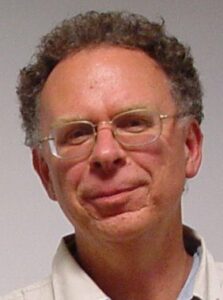 The Littlejohn Research Award was established in 2013. It is named in commemoration of Roger Littlejohn, who worked as a biometrician with AgResearch (formerly Ministry of Agriculture and Fisheries), based at the Invermay Research Centre (Dunedin) for nearly 30 years. A very practical and creative statistician, Roger devised innovative solutions to the many and diverse problems presented to him throughout his career.
Roger was an expert in the analysis of time series and in the application of hidden Markov models, and made major contributions in the analysis of hormone profiles and animal movement-behaviour studies. He contributed to over 200 publications, and was a highly regarded contributor to the GenStat program.
Roger was a stalwart of the NZSA whose roles included that of President, Newsletter Editor and Webmaster.
Roger died in 2011, following a battle with secondary melanoma, having just turned 56.
Roger was posthumously awarded the 2011 Campbell Award in recognition of his significant contribution to the promotion and development of statistics in New Zealand.
If you have any queries about making a nomination/application for this award please email the Convenor of the NZSA Awards Committee.
| Year | Recipients of the Littlejohn Award | |
|---|---|---|
| 2025 | Thomas Yee | |
| 2024 | Tilman Davies |  |
| 2023 | Alain Vandal |  |
| 2022 | Ting Wang |  |
| 2021 | Russell Millar |  |
| 2020 | Renate Meyer | 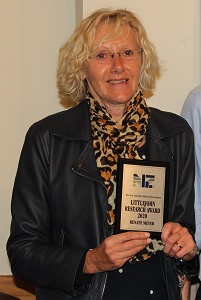 |
| 2019 | Richard Arnold | 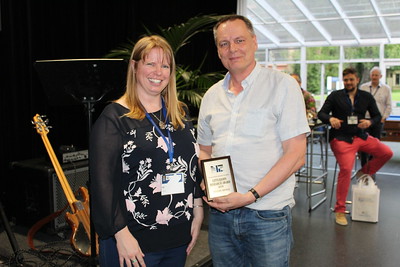 |
| 2017 | Matt Schofield | Newsletter 80 |
| 2016 | Geoff Jones | |
| 2015 | Mark Holmes | |
| 2014 | Martin Hazelton |  |
| 2013 | Richard Barker |