
2025 Recipient: Jason Wen
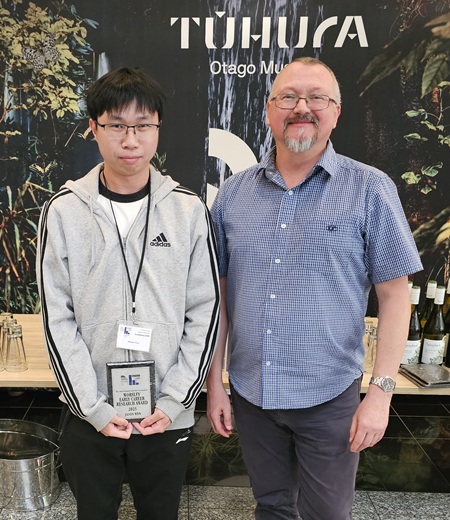
Wen Zhijian (Jason) develops and applies novel machine learning and deep learning methods for the classification and interpretation of forensic evidence. His work allows the quantification of forensic evidential items, such as digital images, that have traditionally been regarded as unquantifiable or poorly treated as massively multivariate observations which ignores the underlying structure inherent in the data. Jason’s work removes much of the variability and subjectivity attributable to humans in a field where such biases can have serious legal implications. The importance of his work cannot be understated.
Jason received his PhD from the University of Auckland in Statistics in 2021. His PhD made novel contributions to the field of forensic statistics in two different fields of forensic science: firearms and glass. Both pieces of work employed relatively modern developments in statistics and machine/deep learning. Jason’s glass work used a Dirichlet process to develop a Bayesian non-parametric/infinite mixture model for forensic glass evidence. This approach allows us to refine our models for the interpretation of forensic glass evidence. Jason turned this part of his thesis into a journal article which was subsequently published in Science & Justice, which is the official journal of the prestigious United Kingdom Chartered Society of Forensic Sciences. Jason also developed a classification method using convolutional neural networks (CNNs), histograms of oriented gradients (HOGs), and support vector machines (SVMs) to distinguish between bullets fired from different rifles on the basis of images of the firing pin impressions left on cartridge cases. This is, I believe, one of the earliest applications of CNNs to forensic evidence. It, for the first time, allowed forensic scientists to consider image data in a statistical framework. This is a seriously important development with a vast array of potential applications. Images are used to record many types of evidential items including, but not restricted to, shoe prints, blood spatter patterns, tool marks, firearms marks (there are other markings left on the cartridge case and bullet/projectile that can be used to link them to the firearm used), and hand-writing. Traditionally, such evidence has been interpreted by expert human examiners who has been shown to be highly subjective, and highly variable. The introduction of deep learning techniques (of which CNNs are one part) is a massive leap forward in terms of firstly eliminating the human element and secondly providing results which are amenable to more impartial statistical treatments. Jason published his work on firing pins in the Journal of Forensic Sciences—the official journal of the American Academy of Forensic Sciences. He then went on to publish two further papers, one on shoeprints, and on automated detection of rulers in forensic images using his knowledge of CNNs and image segmentation techniques.
More recently, Jason helped me and our collaborator Courtney Lynch with what, in some sense, can be regarded a common statistical problem—the classification of an observation that has not been previously observed or for which the classifier has not been trained on. This problem arises for us in the classification of body fluids. The biological methods Jason and we work with are based on messenger RNA (mRNA) and have been developed to classify blood, menstrual blood, semen, saliva, and vaginal fluid. However, they cannot currently correctly identify nasal mucosa, rectal mucosa, or sweat, and mixtures of these fluids with the original five. Ideally, one would like a classifier to return a result of “unknown” when it encounters an observation it does not recognise. Statisticians do not really think much about this problem, but there has been some recent work in the machine learning world. Jason developed a novel method that can reliably classify out-of-training set observations as “unknown” for our body fluid problem. This work was an integral part of our most recent publication (of which Jason is a joint author) in Forensic Science International: Genetics. FSI-Gen is the most prestigious forensic genetics journal in print.
The citation above is from James Curran.
This award recognizes outstanding recent published research from a New Zealand statistician in the early stages of their career.
Next Round
- Next round opens: TBD
- Next round closes: TBD
Nominations should be sent to the Convenor of the NZSA Awards Committee, by email at vanessa.cave@auckland.ac.nz.
Award Details
CriteriaThis award recognizes outstanding recent published research from a New Zealand statistician in the early stages of their career. The criteria for eligibility are the same as for the Marsden Fund Fast-Start grants. Essentially, this means applicants must be within seven years of confirmation of PhD, or their highest completed degree for an applicant without a PhD. Candidates will have completed the majority of this research within New Zealand, and will be financial members of the Association. Previous winners are ineligible for nomination. NominationsNominations can be made by individuals or groups of individuals. Nominators may be non-NZSA members. Nominations will be assessed by the NZSA Awards Committee, and should include the following:
|
Background
 The Worsley Early Career Research Award was established in 2013, in commemoration of Keith Worsley. Keith Worsley was one of the world’s leaders in the field of brain mapping. After completing his PhD at the University of Auckland in 1978, Keith spent most of his professional life at McGill University in Montreal. There, in collaboration with colleagues in the McConnell Brain Imaging Centre at the Montreal Neurological Institute, he made many fundamental contributions to the statistical analysis of functional and structural brain imaging data. He was an Honorary Fellow of the Royal Society of New Zealand, a Fellow of the Royal Society of Canada and a
Canadian Statistical Society Gold Medallist.
If you have any queries about making a nomination/application for this award please email the Convenor of the NZSA Awards Committee.
| Year | Recipients of the NZSA Worsley Award | |
|---|---|---|
| 2025 | Jason Wen |  |
| 2023 | Xun Xiao | 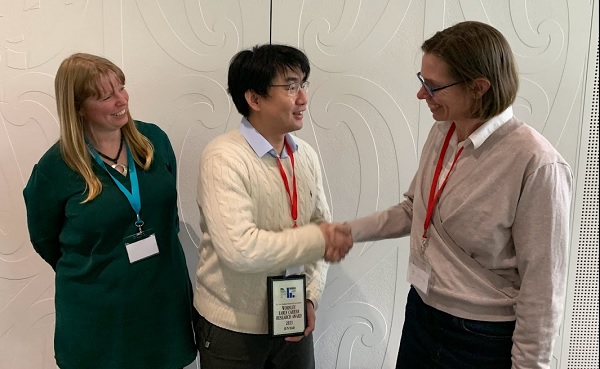 |
| 2022 | Matt Edwards |  |
| 2021 | Charlotte Jones-Todd |  |
| 2019 | Varvara Vetrova | 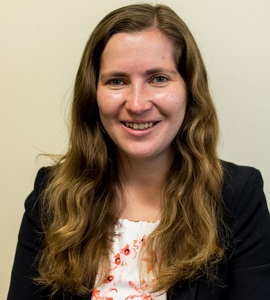 |
| 2018 | Claudia Rivera-Rodriguez | 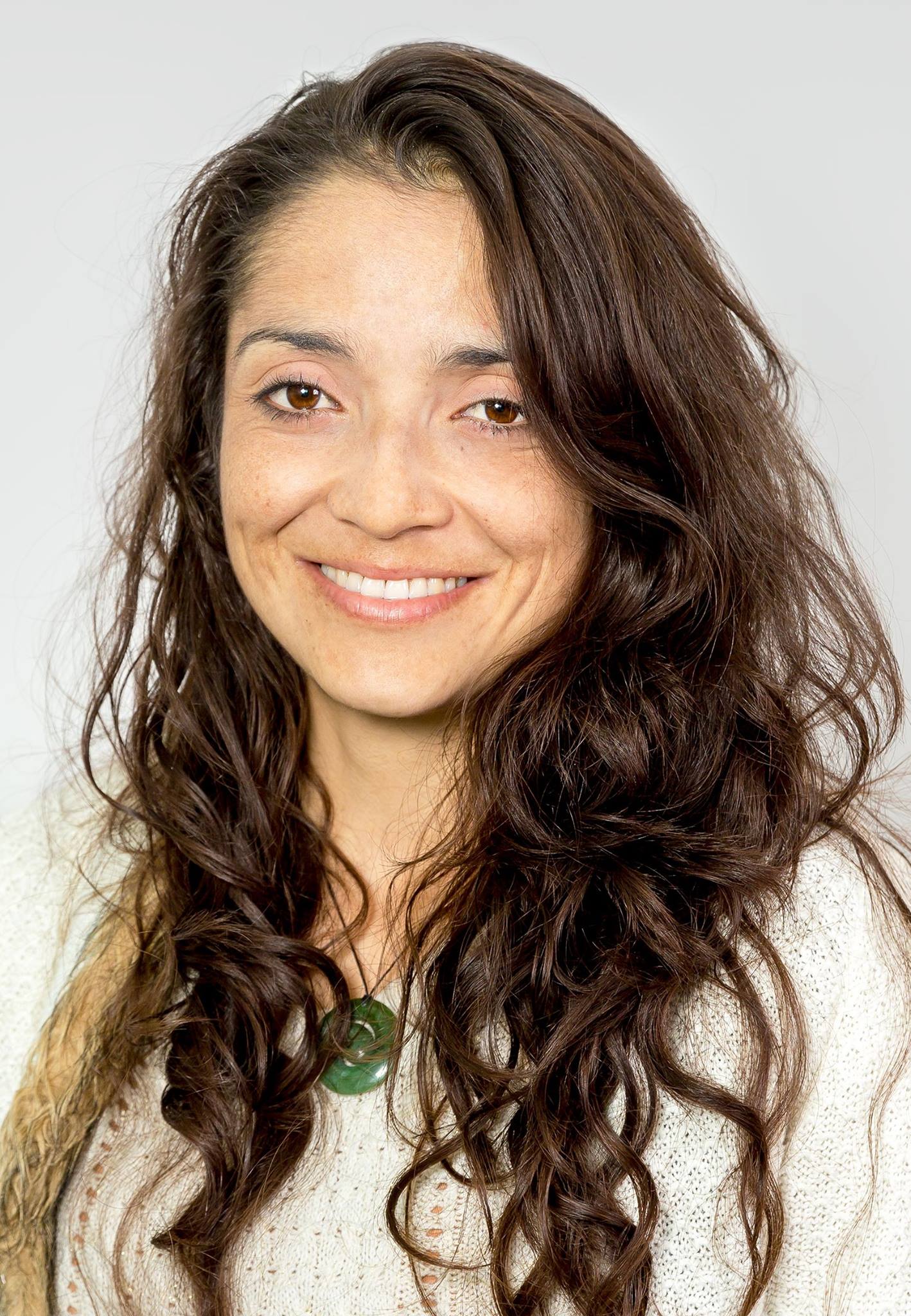 |
| 2017 | Ben Stevenson | Newsletter 80 |
| 2016 | Yalu Wen | |
| 2015 | Blair Robertson | |
| 2014 | Tilman Davies |  |
| 2013 | Ting Wang |  |