

We are pleased to announce that the 2025 NZSA Award recipients are Claire Cameron (Campbell Award), Thomas Yee (Littlejohn Research Award), Jason Wen (Worsley Early Career Research Award) and Harold Henderson (Jean Thompson Award).
| Campbell Award: Claire Cameron (University of Otago) | Citation from Andrew Gray: Research Associate Professor Claire Cameron is an outstanding and highly productive researcher, as demonstrated by her more than 100 publications. Many have been published in high-impact journals, including prestigious outlets such as The Lancet Infectious Diseases, and many have been heavily cited, with some cited over 100 times. Her research excellence is also demonstrated by her success in obtaining external research funding, including several large grants from the Health Research Council. Her publications include a dozen statistics primers for the New Zealand Medical Student Journal, and she has also been involved in many other activities promoting effective use of statistics, particularly in health research. Claire is also an outstanding leader. She provided leadership for two years to the biostatistics group at the University of Otago prior to the formation of the Biostatistics Centre in 2017. She then provided substantial support to the incoming Director during the Centre’s establishment. Claire is now Director of the Centre, a role in which she has flourished and continues to provide mentorship and leadership to many. Alongside her extensive leadership, research, and service roles, Claire has made exceptional contributions to building a community of biostatisticians in Aotearoa New Zealand. These contributions are sometimes single-handed and often collaborative. Highlights include: the Box Plot network, established in 2013; regular meetings of biostatisticians and associated academics on the Dunedin campus, followed by the establishment of a cross-campus group at the University of Otago; the NZ Biostatistics Symposium (2021); the NZ Biostatistics Conference (2023); the inaugural biostatistics session at the NZSA 2025 Conference; the NZSA’s mentoring programme since its inception; and her role as the New Zealand representative on the US-based Caucus of Women in Statistics and Data Science since 2020. Claire has worked tirelessly alongside a diverse range of colleagues and collaborators with the goal of strengthening biostatistics and statistics as disciplines and as careers for future generations. Claire’s sustained advocacy for biostatisticians and biostatistics as a discipline and her leadership in building strong communities make her a truly deserving recipient of the Campbell Award. On behalf of all those in the communities she has helped create and strengthen, and especially on behalf of the Biostatistics Centre and associates, congratulations, Claire, on this well-deserved achievement, and thank you for all that you do. | 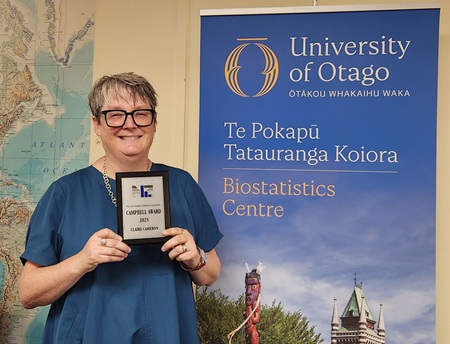 |
| Littlejohn Award: Thomas Yee (University of Auckland) | Citation Chris Wild: Early in his research career, Thomas developed a large umbrella-class of regression models that generalise generalised linear models and generalised additive models. He described this class as “Vector Generalized Linear and Additive Models” with the characteristic that any of the parameters of a base model can be replaced by linear or smooth regression functions of covariates. The class also includes his reduced-rank vector generalised linear models which provide for dimension reduction. Because the VGAM framework covers such a wide swathe of well-known statistical models, the many theoretical and methodological advances that Thomas makes are implemented in his R package VGAM for the full range of models to which they are appropriate. The most complete single account of the VGAM models, and the results of his research in the area at the time, is his 590-page magnum opus published by Springer in 2015. A second edition invited by Springer is well under way. Thomas’s written research is impressive, but I think an even bigger contribution is his ongoing work on his open-source R package VGAM. This is where he first publishes most of his innovations to provide research communities with new, immediately-useable modelling and analysis capabilities. Having so many models linked within a single coherent family makes it enormously easier for researchers to move between models in search of something that better models their data. I’m also reminded that Hadley Wickham’s software is his most important set of research outputs and that Hadley won the 2019 COPSS Award, showing recognition of this form of publication at the highest level. In my view, VGAM is the most flexible statistical modelling system within in a single coherent modelling framework that there is. VGAM is in the top 2% of the 20,000 R packages on CRAN in terms of downloads. Between 2013 and 2018 alone there were approximately 700,000 downloads (data obtained for the 2018 PBRF round). Thomas’s work over the last 5 years continues his expansion of the VGAM class and work on overcoming important and well-known theoretical and practical problems in the fitting of statistical models and making statistical inferences, together with making all of the results available in his software, usually in advance of formal publication. The work is primarily in two areas: (i) likelihood inference and the problems with Wald-test based inferences known as the Hauck– Donner effect (HDE); and (ii) count regression via Generally Altered, Inflated, Truncated and Deflated (GAITD) regression, a super model that can accommodate under-, equi- and over- dispersion relative to the Poisson using a negative binomial (NB) parent, and the GT–Expansion (GTE) method. | 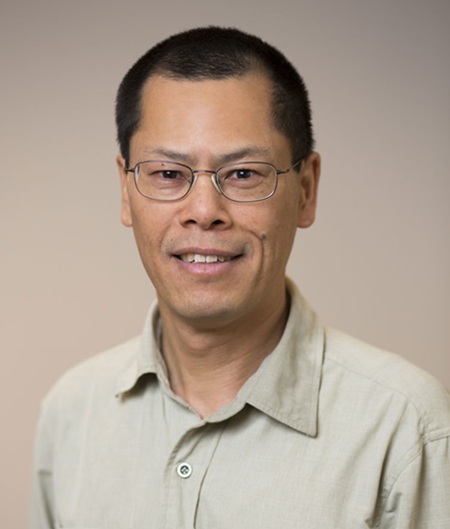 |
| Worsley Award: Jason Wen (PHF Science) | Citation from James Curran: Wen Zhijian (Jason) develops and applies novel machine learning and deep learning methods for the classification and interpretation of forensic evidence. His work allows the quantification of forensic evidential items, such as digital images, that have traditionally been regarded as unquantifiable or poorly treated as massively multivariate observations which ignores the underlying structure inherent in the data. Jason’s work removes much of the variability and subjectivity attributable to humans in a field where such biases can have serious legal implications. The importance of his work cannot be understated. Jason received his PhD from the University of Auckland in Statistics in 2021. His PhD made novel contributions to the field of forensic statistics in two different fields of forensic science: firearms and glass. Both pieces of work employed relatively modern developments in statistics and machine/deep learning. Jason’s glass work used a Dirichlet process to develop a Bayesian non-parametric/infinite mixture model for forensic glass evidence. This approach allows us to refine our models for the interpretation of forensic glass evidence. Jason turned this part of his thesis into a journal article which was subsequently published in Science & Justice, which is the official journal of the prestigious United Kingdom Chartered Society of Forensic Sciences. Jason also developed a classification method using convolutional neural networks (CNNs), histograms of oriented gradients (HOGs), and support vector machines (SVMs) to distinguish between bullets fired from different rifles on the basis of images of the firing pin impressions left on cartridge cases. This is, I believe, one of the earliest applications of CNNs to forensic evidence. It, for the first time, allowed forensic scientists to consider image data in a statistical framework. This is a seriously important development with a vast array of potential applications. Images are used to record many types of evidential items including, but not restricted to, shoe prints, blood spatter patterns, tool marks, firearms marks (there are other markings left on the cartridge case and bullet/projectile that can be used to link them to the firearm used), and hand-writing. Traditionally, such evidence has been interpreted by expert human examiners who has been shown to be highly subjective, and highly variable. The introduction of deep learning techniques (of which CNNs are one part) is a massive leap forward in terms of firstly eliminating the human element and secondly providing results which are amenable to more impartial statistical treatments. Jason published his work on firing pins in the Journal of Forensic Sciences—the official journal of the American Academy of Forensic Sciences. He then went on to publish two further papers, one on shoeprints, and on automated detection of rulers in forensic images using his knowledge of CNNs and image segmentation techniques. More recently, Jason helped me and our collaborator Courtney Lynch with what, in some sense, can be regarded a common statistical problem—the classification of an observation that has not been previously observed or for which the classifier has not been trained on. This problem arises for us in the classification of body fluids. The biological methods Jason and we work with are based on messenger RNA (mRNA) and have been developed to classify blood, menstrual blood, semen, saliva, and vaginal fluid. However, they cannot currently correctly identify nasal mucosa, rectal mucosa, or sweat, and mixtures of these fluids with the original five. Ideally, one would like a classifier to return a result of “unknown” when it encounters an observation it does not recognise. Statisticians do not really think much about this problem, but there has been some recent work in the machine learning world. Jason developed a novel method that can reliably classify out-of-training set observations as “unknown” for our body fluid problem. This work was an integral part of our most recent publication (of which Jason is a joint author) in Forensic Science International: Genetics. FSI-Gen is the most prestigious forensic genetics journal in print. | 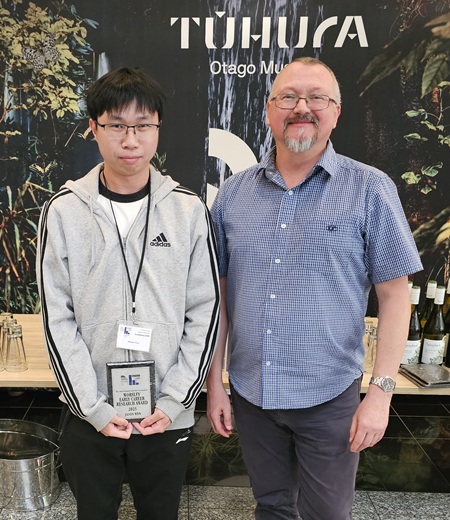 |
| Jean Thompson Award: Harold Henderson (AgResearch Group, Bioeconomy Sciences Institute) | Citation from Neil Cox and Ken Dodds: Harold Henderson has made an enormous contribution to the application of statistical methods in New Zealand industries. Harold has been a statistician with the Ministry of Agriculture and Fisheries (MAF) and continuing with the formation of AgResearch. Harold started work with MAF in Wellington in 1974 before getting an NRAC Fellowship and going to Cornell for his doctoral studies with Shayle Searle, returning to MAF at Ruakura in 1979. Harold has collaborated in a wide range of projects including animal physiology and endocrinology, livestock production including dairy foods, molecular biology, pastures and crops, animal health, animal reproduction, animal behaviour, human health and nutrition, and environmental science. Much of this work has resulted in his 61 refereed papers, published between 1977 and 2024. Harold has a wide-ranging set of interests including the use of matrix algebra in statistics, unbalanced data, generalised linear models, regression analysis, and curve fitting. In 1997 he received a Prince & Princess of Wales Science Award to visit Cornell to pursue interests in exploratory data analysis, statistics packages and the graphical display of data. He returned with a particular interest in dynamic graphics and adopted the early use of such software including the DataDesk package. Harold has been a vital part of the Ruakura team over the years, being a highly valued and sought-after collaborator on research projects, a respected mentor to others in the team and particularly to new graduates starting work or on work experience. One of Harold’s strongest contributions to statistics in New Zealand has been through encouraging, mentoring and connecting statisticians. Harold has served on NZSA committees in various roles over a long period including president (1993-1995), newsletter co-editor (1989-1993), awards committee (2004-present), membership secretary (1989-2023), retiring from the exec committee in 2023 but still supporting the association informally such as with email communications. He was awarded Life Membership of the NZSA in 2013. He has also been heavily involved in organizing national and international conferences. These include the joint International Biometrics and NZSA conference at the University of Waikato in 1992 where there were 461 delegates representing 36 countries. In 2001 he was part of a team that organized the Australasian Biometrics and NZSA Joint Conference in Christchurch. At these and many other events he has been the unofficial photographer and has shared these photographs with the statistics community. Even though he began phased retirement in 2018, Harold continues to have regular contact with colleagues, continuing to do some unpaid work on research projects, giving advice and assistance to younger members of staff, and attending the Ruakura statisticians’ Tuesday morning teas. | 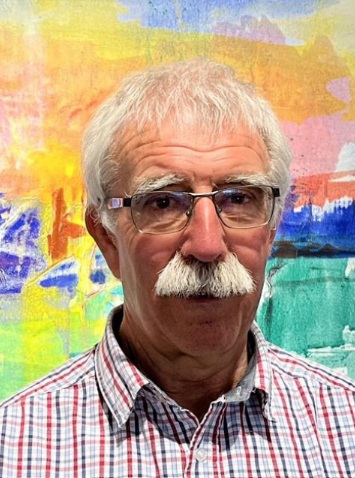 |